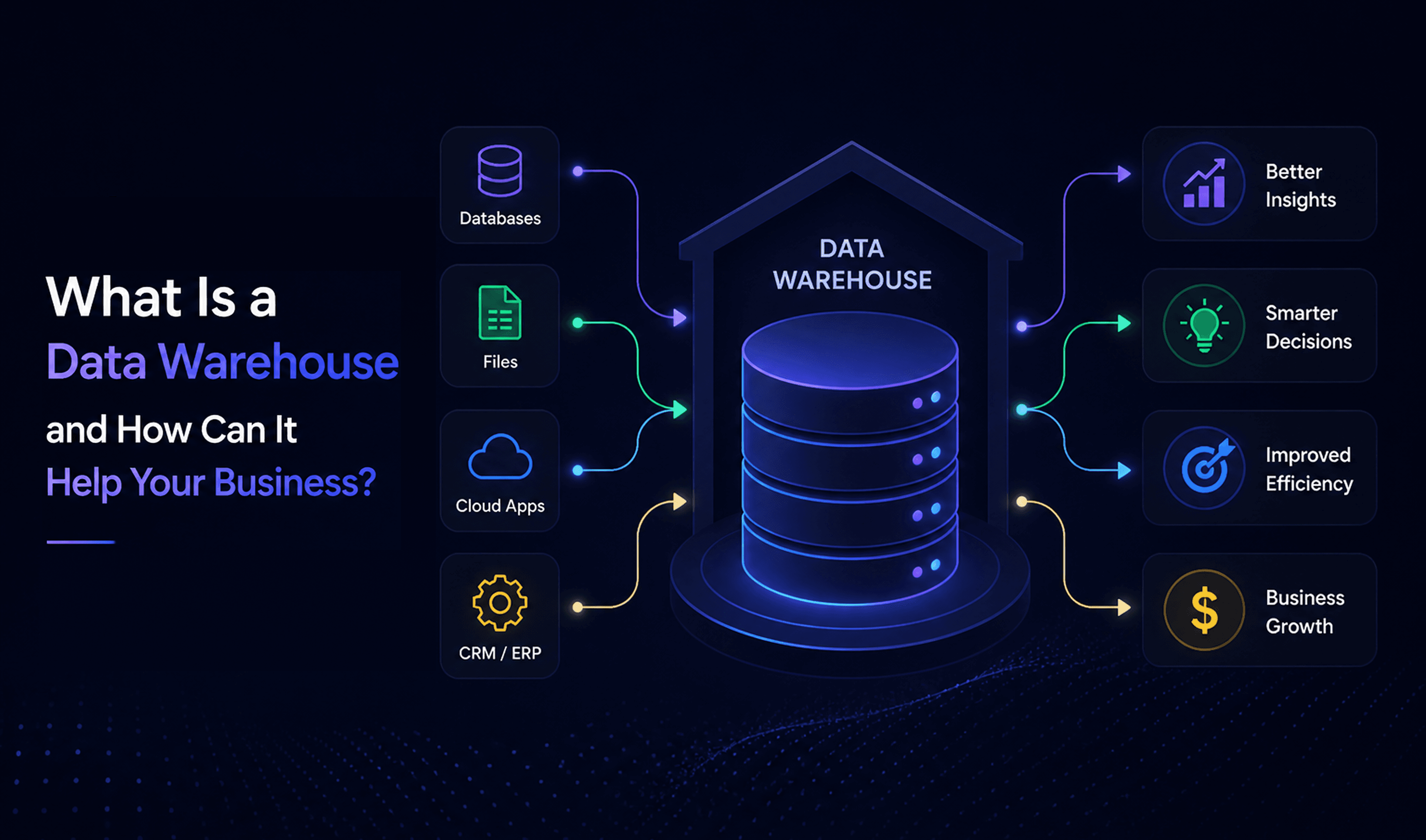
This guide explains what a data warehouse is, how it works, how it compares to other data storage options, and, most importantly, what it can actually do for your business.
What Is a Data Warehouse? (The Plain-Language Version)
A data warehouse is a central storage system that collects, organises, and holds large volumes of data from across your business so that you can analyse it, report on it, and make better decisions from it.
Think of it like a library. Your individual databases and business tools are like separate bookstores, each stocking its own selection, organised its own way. A data warehouse is the library: a single place where all those books have been catalogued, organised consistently, and made searchable in one go.
More specifically, here is what a data warehouse does:
It pulls data from multiple sources across your business, your CRM, your accounting software, your website analytics, your inventory system, and your marketing platforms, through a process called ETL (Extract, Transform, Load). It extracts that data, cleans and standardises it, and loads it into a single repository where it can be queried and analysed together.
The result is what data professionals call a "single source of truth": one place where everyone in your business can access the same reliable, consistent, up-to-date data without needing to cross-reference spreadsheets from three different departments.
As of 2025, the global data warehousing market has grown to over $37 billion and is projected to reach nearly $70 billion by 2029. That growth reflects how central data warehouses have become to how modern businesses operate and compete.
How Is a Data Warehouse Different from a Database?
This is one of the first questions business owners ask, and it is worth answering clearly because the distinction is meaningful.
A regular database is designed for day-to-day operations. When a customer places an order, the order details go into your database. When a staff member logs a support ticket, it goes into a database. Databases are built for speed and accuracy in recording and retrieving individual pieces of current information. They are optimised for transactions: doing things quickly, one at a time.
A data warehouse is designed for analysis. It holds large volumes of historical data from multiple sources, structured specifically so that you can run complex queries across it, things like "show me all orders from customers who joined in the last two years, segmented by region, and compare their average spend to the previous cohort." Trying to run that kind of query on an operational database would be slow, disruptive, and often simply impossible.
The simplest way to understand the distinction is this: a database tells you what is happening right now. A data warehouse tells you what has happened, why, and what patterns exist across time and across your entire business.
There is a third term worth knowing: a data lake. A data lake stores raw, unprocessed data in any format, structured, semi-structured, or completely unstructured, like audio files or raw text. Data lakes are flexible and cheap to store data in, but they require significant technical expertise to extract useful insights from. For most small and medium-sized businesses, a data warehouse is the appropriate starting point. Data lakes are typically more relevant to organisations with large data science teams and complex machine learning use cases.
Here is a simple comparison:
alogued, organised consistently, and made searchable in one go.
More specifically, here is what a data warehouse does:
It pulls data from multiple sources across your business, your CRM, your accounting software, your website analytics, your inventory system, and your marketing platforms through a process called ETL (Extract, Transform, Load). It extracts that data, cleans and standardises it, and loads it into a single repository where it can be queried and analysed together.
The result is what data professionals call a "single source of truth": one place where everyone in your business can access the same reliable, consistent, up-to-date data without needing to cross-reference spreadsheets from three different departments.
As of 2025, the global data warehousing market has grown to over $37 billion and is projected to reach nearly $70 billion by 2029, according to BayTech Consulting. That growth reflects how central data warehouses have become to how modern businesses operate and compete.
How Is a Data Warehouse Different from a Database?
This is one of the first questions business owners ask, and it is worth answering clearly because the distinction is meaningful.
A regular database is designed for day-to-day operations. When a customer places an order, the order details go into your database. When a staff member logs a support ticket, it goes into a database. Databases are built for speed and accuracy in recording and retrieving individual pieces of current information. They are optimised for transactions, doing things quickly, one at a time.
A data warehouse is designed for analysis. It holds large volumes of historical data from multiple sources, structured specifically so that you can run complex queries across it, things like "show me all orders from customers who joined in the last two years, segmented by region, and compare their average spend to the previous cohort." Trying to run that kind of query on an operational database would be slow, disruptive, and often simply impossible.
The simplest way to understand the distinction is this: a database tells you what is happening right now. A data warehouse tells you what has happened, why, and what patterns exist across time and across your entire business.
There is a third term worth knowing: a data lake. A data lake stores raw, unprocessed data in any format, structured, semi-structured, or completely unstructured, like audio files or raw text. Data lakes are flexible and cheap to store data in, but they require significant technical expertise to extract useful insights from. For most small and medium-sized businesses, a data warehouse is the appropriate starting point. Data lakes are typically more relevant to organisations with large data science teams and complex machine learning use cases.
Here is a simple comparison:
| Database | Data Warehouse | Data Lake | |
|---|---|---|---|
| Primary purpose | Running operations | Business analytics and reporting | Big data storage and data science |
| Data type | Current, structured | Historical, structured | Any type, raw |
| Query speed | Fast for transactions | Optimized for complex analysis | Slower, needs transformation |
| Primary users | Applications, operations staff | Business analysts, decision-makers | Data scientists, engineers |
| Best for | Powering your tools | Making business decisions | Machine learning and research |
How Does a Data Warehouse Work? (Step by Step)
You do not need to understand the technical architecture in detail to make good decisions about data infrastructure. But a basic understanding of the process helps you ask the right questions and have more productive conversations with your IT team or technology partner.
- Data extraction. Data is pulled from all of your source systems: your CRM, your ERP or accounting software, your e-commerce platform, your marketing tools, your customer service platform, and any other system that generates business data. This happens on a schedule (nightly, hourly, or in real time, depending on your needs and your warehouse setup).
- Data transformation. Raw data from different systems is rarely consistent. Your CRM might record customer names in full while your billing system uses an account number. Dates might be formatted differently. Product names might be spelled differently across systems. The transformation step cleans, standardises, and restructures all of this data so it is consistent and usable. Duplicate records are removed, errors are corrected, and everything is converted into a common format.
- Data loading. The cleaned, standardised data is loaded into the central data warehouse, organised into a structure that makes it easy to query and analyse. Most modern data warehouses use a dimensional model (often a "star schema" or "snowflake schema"), which organises data around key business entities like customers, products, transactions, and time periods.
- Analysis and reporting. Once data is in the warehouse, business analysts and decision-makers can connect business intelligence (BI) tools like Microsoft Power BI, Tableau, Looker, or Google Data Studio to query the warehouse and produce reports, dashboards, and visualisations. These are the outputs that actually reach the desks of sales directors, finance managers, and chief executives.
One of our SMB clients was pulling data manually from five different systems every Monday morning to produce a weekly performance report. The process took nearly a full day of analyst time. After implementing a cloud data warehouse connected to a BI dashboard, that same report was generated automatically overnight and available to leadership at 8 am. The analyst's time was redeployed to actual analysis: asking questions of the data, rather than just moving it.
To learn more about how we implement data warehouse and analytics solutions for businesses, visit our Data Warehouse and Analytics services page.
What Can a Data Warehouse Actually Do for Your Business?
The technology itself is not the point. What it enables is. Here is what businesses consistently report gaining after implementing a data warehouse.
A single source of truth
68% of businesses say data warehousing has improved their ability to respond to market changes effectively. The reason is that a data warehouse eliminates the confusion of conflicting data from different departments. When marketing says conversion is up and finance says revenue is flat, a data warehouse gives you the unified view that resolves the contradiction. According to Gartner research cited by IBM, poor data quality costs organisations an average of $12.9 million per year. Data warehouses directly address this by building data quality into the ETL process itself.
Faster, better business decisions
When data is clean, centralised, and accessible, decision-makers stop waiting for reports and start asking questions. Can we afford to expand into a new market? Which product lines are driving the most profit? Which customer segments are at risk of churning? These questions can be answered in minutes on a well-configured data warehouse, rather than days of manual data assembly.
According to Forrester research on data and analytics investments, mature data and analytics programmes deliver 2 to 5x ROI across revenue growth, cost efficiency, and risk reduction. Organisations that quantitatively measure the impact of their data investments consistently show stronger growth and higher stakeholder confidence.
Reliable historical analysis
One of the most powerful things a data warehouse does is preserve and organise historical data in a way that makes it comparable over time. You can look at sales performance in Q2 this year versus Q2 last year, controlling for the same variables, with confidence that you are comparing like with like. This kind of longitudinal analysis is extremely difficult to do reliably with data that lives in disconnected operational systems.
Reduced reporting burden on your team
Manual reporting is one of the highest hidden costs in data-immature businesses. Analysts and managers spending hours each week assembling data that could be generated automatically represents a significant opportunity cost. Automating reporting through a data warehouse frees those people to do what they are actually paid for: interpreting data and making decisions, not moving it between spreadsheets.
Better customer understanding
When you can connect your sales data with your marketing data with your customer service data with your web analytics, you build a genuinely complete picture of your customer: how they found you, what they bought, how they engaged with support, and what their lifetime value looks like. This kind of unified customer view is not possible without a data warehouse, and it is the foundation for smarter marketing, better retention, and higher lifetime customer value.
Scalability as you grow
As your business grows, your data volume grows with it. A properly designed data warehouse scales with you. Cloud-based data warehouses in particular can handle enormous increases in data volume without requiring infrastructure investment, because you pay for what you use. By 2025, 85% of organisations are expected to have adopted a cloud data warehousing solution, with cloud-based warehousing growing at approximately 15% CAGR.
On-Premise vs. Cloud Data Warehouse: What Is Right for Your Business?
Ten years ago, most data warehouses lived on physical servers in company data centres. Today, the majority of new implementations are cloud-based, and for good reason.
On-premise data warehouses give businesses full control over their data and infrastructure. They can be appropriate for organisations with strict data sovereignty requirements, existing infrastructure investment, or very predictable, stable workloads. The downsides are significant upfront hardware costs, ongoing maintenance requirements, and limited scalability.
Cloud data warehouses, including Snowflake, Google BigQuery, Amazon Redshift, and Microsoft Azure Synapse, offer on-demand scalability, pay-as-you-go pricing, no hardware to maintain, and typically faster deployment. For most small and medium-sized businesses, cloud data warehouses are the clear choice: they are accessible, affordable, and managed by the provider.
Cloud-based data warehouses offer instant scalability, universal accessibility, and often stronger security compared to on-premise options. Nearly all cloud data warehouses automatically conduct backups, ensuring 99.99% data availability and fault tolerance.
A hybrid approach is also common. 53% of IT managers and executives consider hybrid or multi-cloud data warehouses increasingly important, allowing businesses to keep sensitive data on-premise while leveraging cloud scalability for other workloads.
The Most Common Data Warehouse Platforms in 2025
You do not need to choose a platform before understanding what a data warehouse is, but knowing the landscape helps. Here are the major platforms your IT team or technology partner is likely to recommend.
- Snowflake is the market leader in cloud data warehousing. It is known for its ease of scaling, strong data sharing capabilities, and separation of storage and compute, which keeps costs predictable.
- Google BigQuery is Google's serverless cloud data warehouse. It is pay-per-query rather than per-instance, making it particularly cost-effective for organisations with variable query volumes. It integrates tightly with Google's analytics and AI ecosystem.
- Amazon Redshift is AWS's data warehouse offering, deeply integrated with the Amazon ecosystem. Organisations already running infrastructure on AWS typically find Redshift a natural choice.
- Microsoft Azure Synapse Analytics combines data warehousing with big data analytics, integrating tightly with Power BI and the wider Microsoft 365 ecosystem. For businesses already using Microsoft products, it is often the most seamless path.
- Databricks takes a "lakehouse" approach, combining the flexibility of a data lake with the analytical capabilities of a data warehouse. It is particularly strong for organisations with advanced AI and machine learning requirements alongside their analytics needs.
Signs Your Business Is Ready for a Data Warehouse
Not every business needs a data warehouse immediately. But there are clear signals that the time has come. You are likely ready if:
- You have data spread across more than three or four systems, and no reliable way to see all of it in one place.
- Your team is spending significant time each week manually pulling and combining data for reports.
- Business leaders are making decisions based on gut feel because the data needed to support them is too hard to access
- You have experienced conflicting reports from different departments because they are each working from different data.
- You are growing fast and anticipate significantly more customers, transactions, and data volume in the next 12 to 24 months.
- You want to build meaningful customer analytics, profitability analysis, or operational reporting that goes beyond what your individual tools can produce
- You are operating in a regulated industry and need audit-ready data trails and consistent reporting.
If two or more of these apply to your business, it is worth having a conversation with a data specialist about what a data warehouse implementation would look like for your specific situation.
Frequently Asked Questions (FAQ)
1. What is a data warehouse in simple terms?
A data warehouse is a centralised storage system that collects data from all of your business systems, CRM, accounting, marketing, and customer service, cleans and organises it, and makes it available for analysis and reporting. Instead of having data scattered across disconnected tools, a data warehouse gives your business one reliable place to access all of it together.
2. Do small businesses need a data warehouse?
Not always immediately, but sooner than most expect. If your business collects data from more than two or three systems and you find it difficult to answer basic business questions without manual data assembly, a data warehouse is worth exploring. Cloud-based data warehouse solutions have made the technology significantly more accessible and affordable for small and medium-sized businesses than it was even five years ago.
3. What is the difference between a data warehouse and a database?
A database is designed for running day-to-day operations: recording transactions, managing customer records, and processing orders. It is fast for individual lookups and writes. A data warehouse is designed for analysis. It holds large volumes of historical data from multiple sources, structured for complex queries across time and across your entire business. Databases power your tools. Data warehouses inform your decisions.
4. What is ETL, and why does it matter?
ETL stands for Extract, Transform, Load: the three-step process by which data is pulled from source systems, cleaned and standardised, and loaded into the data warehouse. ETL is what makes a data warehouse reliable. It ensures that data from different systems is made consistent before it enters the warehouse, so that the analysis built on top of it can be trusted.
5. How much does a data warehouse cost?
Costs vary significantly depending on the platform, data volume, and complexity of implementation. Cloud data warehouse platforms typically charge based on storage and compute usage, making them accessible to businesses of many sizes. Entry-level cloud implementations for small businesses can start from a few hundred dollars per month. A full enterprise implementation with complex data pipelines and custom BI tooling can run to tens of thousands. The most accurate way to understand what it would cost for your specific situation is to speak with a data implementation specialist who can scope your requirements.
6. How long does it take to implement a data warehouse?
A basic cloud data warehouse connecting a small number of source systems and delivering a core set of reports can be implemented in four to twelve weeks. More complex implementations with many data sources, custom transformation logic, and sophisticated BI tooling take longer. The most important factor is the quality and cleanliness of your existing data: businesses with well-maintained source systems move faster than those with messy, inconsistent data that needs significant cleaning.
7. What is a cloud data warehouse?
A cloud data warehouse is a data warehouse hosted by a third-party cloud provider (like Google, Amazon, or Microsoft) rather than on physical servers in your own office or data centre. Cloud data warehouses offer on-demand scalability, pay-as-you-go pricing, automatic backups, and no hardware maintenance. For most growing businesses, cloud data warehouses are the recommended starting point.
8. What business intelligence tools connect to a data warehouse?
The most widely used BI tools that connect to data warehouses include Microsoft Power BI, Tableau, Looker (Google), Metabase, Qlik, and Google Data Studio. These tools allow business analysts and non-technical users to build dashboards, run reports, and visualise data from the warehouse without writing code. The right choice depends on your team's technical comfort level, your existing technology stack, and your budget.
Final Thoughts
Data is one of the most valuable assets a growing business has. But data that lives in silos, disconnected, inconsistent, and impossible to analyse across systems, delivers almost none of its potential value.
A data warehouse is the infrastructure that changes that equation. It brings your data together, makes it trustworthy, and makes it accessible to the people who need to make decisions with it.
The businesses that invest in this foundation, even at a modest, right-sized scale appropriate to their size, consistently outperform those that do not. They make faster decisions because they do not have to wait for manual reports. They make better decisions because they are working from complete, reliable data rather than partial information. And they scale more efficiently, because their data infrastructure grows with them rather than becoming a bottleneck.
If your business is at the stage where data is starting to feel like a problem rather than an asset, a data warehouse is almost certainly part of the answer. Visit our Data Warehouse and Analytics services to explore how we can help.