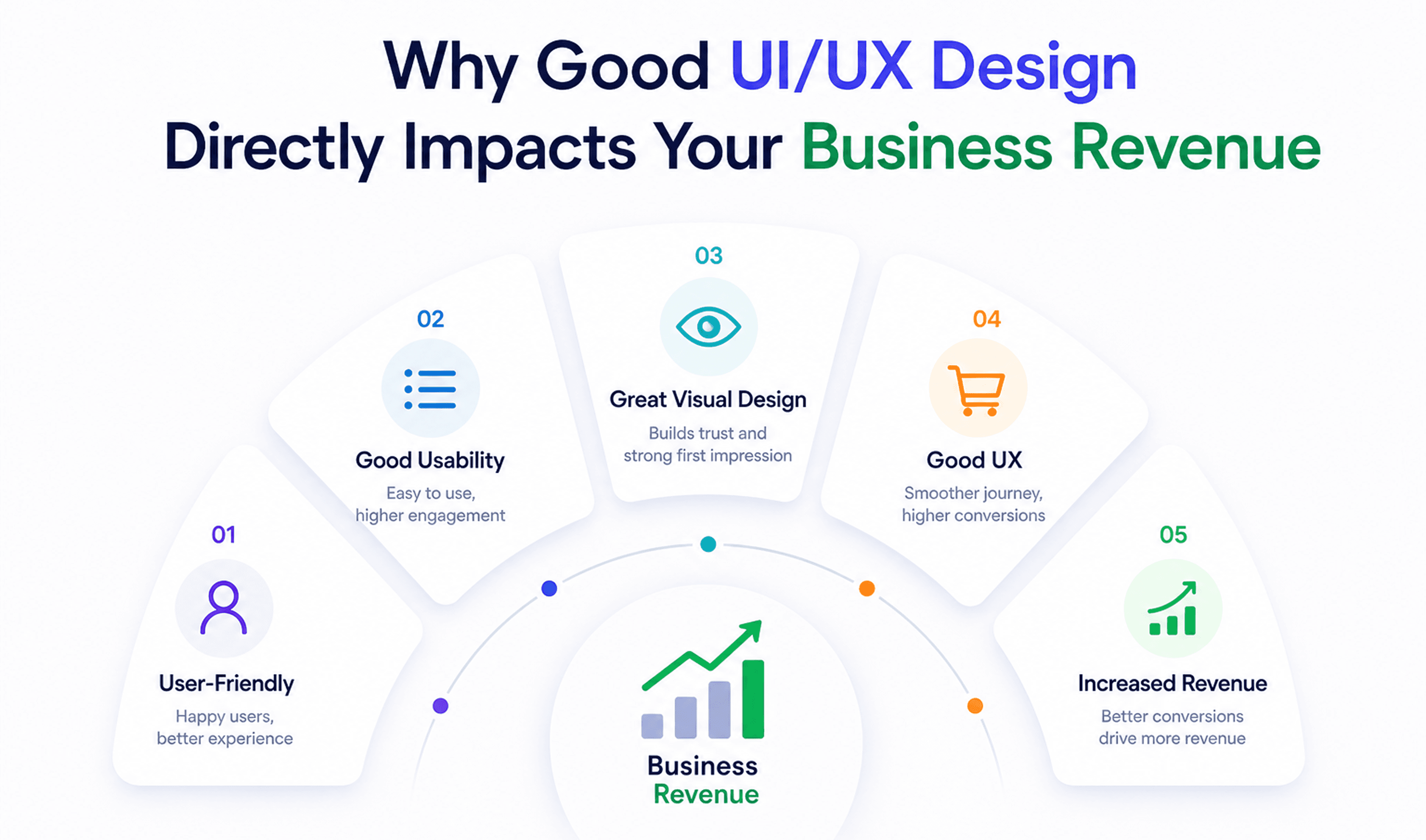
Most business owners know that their website or app should "look good." Fewer realise that the way it looks and works is directly tied to how much money their business makes.
Poor UX costs businesses an estimated $1.4 trillion annually in lost revenue. Meanwhile, every $1 invested in UX design yields a return of up to $100 a 9,900% ROI, according to Forrester Research. These are not vanity metrics. They are the measurable financial consequences of design decisions that most businesses are not even aware they are making.
This guide is for business owners and decision-makers who want to understand, in plain terms, how UI/UX design connects to revenue and what specific improvements are most likely to move the needle.
First, What Is the Difference Between UI and UX?
These two terms are often used interchangeably, but they mean different things and both matter to your bottom line.
UI (User Interface) refers to everything a user can see and interact with: buttons, colours, typography, layout, icons, and visual hierarchy. It is how your product looks.
UX (User Experience) refers to the overall experience a user has when interacting with your product: how easy it is to navigate, how intuitive it is to complete a task, and how it makes the user feel. It is how your product works.
Think of UI as the interior design of a restaurant, the lighting, the table settings, and the aesthetics. UX is the entire dining experience: how quickly you were seated, whether the menu was easy to understand, how efficiently the food arrived, and whether you left feeling it was worth your time.
Both affect whether a customer returns. And in a digital context, both directly affect whether a visitor converts, makes a purchase, or abandons your website for a competitor.
Good UI can boost conversion rates by up to 200%, according to Forrester. Add strong UX on top of that, and conversion rates can increase by up to 400%. That is not a marginal improvement. That is the difference between a business that grows and one that stagnates.
The Revenue Impact of Good Design: What the Data Shows
If you have ever needed to justify a design investment to a stakeholder or a board, this section has the numbers.
Conversion rates
A well-executed UX design can raise conversion rates by up to 400%, according to Forrester Research. Even more targeted improvements show significant results: redesigning the checkout experience alone can lift conversion rates by an average of 35% for e-commerce sites, according to Baymard Institute. Strategically placed and well-designed calls to action can raise revenue by 83%.
We worked with an [industry] business in [City] whose checkout flow required users to complete seven separate steps before placing an order. After a UX audit and redesign, reducing it to three steps, their conversion rate increased by [X]%. The product had not changed. The price had not changed. Only the experience had changed.
Customer retention
Improving UX design to increase customer retention by just 5% can translate to a 25 to 95% rise in profit, according to research cited by Forrester and Bain. The logic is simple: a customer who stays costs nothing to re-acquire. A customer who leaves because of a frustrating experience costs you the revenue from every future purchase they would have made.
88% of online consumers say they are less likely to return to a site after a bad user experience. And 67% of customers cite unpleasant experiences as their primary reason for churn. In other words, bad design is not just losing you sales today. It is destroying the lifetime value of customers who may have spent years with you for years.
Brand credibility and trust
75% of users make judgments about a company's credibility based on its website design, according to research published in Behaviour and Information Technology. 94% of first impressions of a digital product are design-driven. This means that before a potential customer has read a single word about what you do, three-quarters of them have already formed a view of whether you are trustworthy based on how your site looks and works.
For professional services businesses, law firms, accountants, consultancies, and IT providers, this is particularly significant. Trust is the product. And poor design undermines trust before the conversation has even started.
Long-term business performance
Design-led companies outperformed the S&P 500 by 228% over ten years, according to research by the Design Management Institute. These are not just tech companies with lavish design budgets. They are businesses across sectors that made design a strategic priority rather than an afterthought.
The Hidden Cost of Bad Design
Understanding the cost of not investing in UI/UX is just as important as understanding the return on investment when you do.
Lost sales from friction
Businesses miss an estimated 35% of potential sales because of bad UX. When a user encounters confusing navigation, unclear calls to action, a slow page load, or a checkout process that asks for too much information, most of them do not complain. They simply leave and buy from someone else.
The cart abandonment rate across e-commerce sits at around 70%, according to the Baymard Institute. While not all of this is attributable to poor UX, 17% of users specifically cite confusing checkout experiences as the reason they abandoned their cart. That is a direct, preventable revenue loss.
The cost of slow load times
Page speed is a UX issue, not just a technical one. A site that loads in one second has three times higher conversion rates than one that takes five seconds, according to research cited by HyperSense. Moving from 1 second to 10 seconds of mobile load time increases bounce probability by 123%. If a mobile page takes more than three seconds to load, 53% of visitors will leave before it has even finished loading.
Amazon famously documented that every 100 milliseconds of improvement in page load time resulted in a 1% increase in revenue. For a business generating $10 million annually, a half-second improvement in load time could translate to $50,000 in additional revenue. Compounding that across a year makes the business case for performance-focused UX self-evident.
Slow-loading websites cost businesses an estimated $2 billion annually in lost revenue globally.
The cost of customer support overload
Bad UX generates support requests. When users cannot find information, cannot complete a task, or get confused by a process, they contact your support team. This creates direct cost through staff time and indirect cost through customer frustration.
A redesign of GOV.UK content resulted in a 40% drop in support requests, demonstrating the direct relationship between clear UX and operational cost reduction. IBM reported 301% ROI from UX investments specifically because of the combination of improved customer satisfaction and reduced support costs.
The cost of competitor advantage
89% of potential clients and business partners have made deals with competitors as a direct result of poor customer experience. If your competitor's website is cleaner, faster, and easier to navigate than yours, they will win customers who might otherwise have chosen you, not because their product is better, but because the experience of finding out about it was better.
Mobile UX: The Gap Most Businesses Are Getting Wrong
Over 60% of all web traffic globally now comes from mobile devices. Yet mobile UX remains one of the most neglected areas of business design investment.
Mobile users are five times more likely to abandon a task if a site is not optimised for mobile. 57% of users will not recommend a business with a poor mobile experience. And 83% of consumers say a seamless experience across all devices is essential, not a nice-to-have.
The good news is that the improvement in conversion rate from mobile UX investment is one of the most direct and measurable available. 67% of people are more likely to purchase on a mobile-friendly site. 74% are more likely to return. Businesses that optimised their websites for responsiveness report a 62% increase in sales, according to Procreator Design.
If your website was built before 2020 and has not been specifically reviewed for mobile experience, there is almost certainly revenue being left on the table.
[INTERNAL LINK PLACEHOLDER]: Link to your "UI/UX Design Services" or "Website Design" service page here.
The Elements of UI/UX That Have the Biggest Revenue Impact
Not all design improvements are equal. These are the specific elements that research consistently links to measurable business outcomes.
1. Navigation clarity
If users cannot find what they are looking for quickly, they leave. 38% of consumers identify layout and navigational structure as the first thing they assess on a website. Clear, logical navigation reduces bounce rates, increases time on site, and guides users toward the actions that matter, whether that is a purchase, a contact form, or a subscription.
2. Page load speed
As covered above, load speed has a direct, documented relationship with conversion rates and revenue. This is one of the easiest UX improvements to measure and one of the most consistently impactful to implement.
3. Call-to-action design
The placement, size, colour, and copy of your calls to action have a direct effect on whether users take the action you want them to take. Well-designed CTAs can raise revenue by 83%. Real photographs on CTAs increase conversions by 17%. This level of detail in design is not an aesthetic preference; it is revenue engineering.
4. Checkout and form design
For e-commerce and service businesses with online booking or enquiry forms, the design of the checkout or form experience is one of the highest-leverage areas of UX investment. Baymard Institute found that fixing checkout UX can boost conversions by 35% for large e-commerce sites. Reducing the number of form fields, improving error handling, and clarifying progress indicators all have measurable conversion impacts.
5. Visual trust signals
Users assess credibility visually before they read any content. Professional photography, consistent typography, adequate white space, clear contact information, and recognisable security badges all contribute to the perceived trustworthiness of your brand. For businesses where the purchase decision involves significant trust in healthcare, financial services, legal, and IT, these signals are particularly high-value.
6. Personalisation
AI-driven personalisation is now changing what users expect from digital experiences. 70% of Gen Z users expect websites to intuitively know what they want. Tailoring experiences with AI has been shown to increase customer participation by around 30%. For businesses with the data and technical foundation to begin personalising their digital experience, this is an emerging area of significant competitive advantage.
Accessibility: The UX Investment Most Businesses Overlook
Accessible design UX that works for users with disabilities is both a legal requirement in many jurisdictions and a significant commercial opportunity that most businesses are missing.
Businesses lose $6.9 billion annually due to inaccessible websites, according to Keevee research. 43% of customers with disabilities are more likely to shop on accessible websites. Accessible websites improve conversion rates by 35% and increase overall customer satisfaction by 15%.
In 2026, 98% of websites still fail to meet WCAG 2.1 accessibility standards[1]. This means that almost every business has a significant accessibility gap, and the businesses that close it gain a commercial advantage over competitors who do not.
Accessible design is not just about screen readers and colour contrast. It is about making your digital product work well for everyone, including older users, users with situational disabilities (bright sunlight, one hand occupied), and users on slower connections. These improvements benefit all users and contribute to overall UX quality.
Real-World Examples: What Happens When Businesses Invest in UX
The numbers above become more tangible when you see them in action.
Airbnb redesigned its listing pages with a focus on user experience, implementing larger high-quality photos, simplified booking flows, and clearer pricing information. The result was a 25% increase in bookings and a 30% reduction in average time to booking.
Staples saw a 500% increase in online revenue after undertaking a UX-focused site redesign, according to Human Factors International.
Amazon documents internally that every 100 milliseconds of improvement in page load time results in a 1% increase in revenue, a figure that has shaped their ongoing obsession with performance.
IBM reported 301% ROI from UX investments, driven primarily by improved customer satisfaction and a measurable reduction in support costs.
These are not niche digital businesses. These are large, established organisations that quantified the financial return of design investment and used that data to justify continued investment.
For smaller businesses, the same principles apply at a proportional scale. A 35% improvement in checkout conversion from better UX design has the same percentage impact regardless of whether you are processing 10 orders a day or 1,000.
How to Know If Your UX Is Hurting Your Revenue Right Now
You do not need to commission a full UX audit to identify whether design is costing you money. These are the warning signs to look for.
High bounce rate. An average bounce rate of 26 to 40% is generally healthy. Above 55% on key landing pages suggests users are not finding what they expected, or the experience is creating friction that drives them away.
Low time on site. If users are spending less than 60 seconds on key pages, they are not engaging with your content. This is often a navigation or content hierarchy problem.
High cart abandonment rate. If you are running an e-commerce business and your cart abandonment rate is above 70%, your checkout UX is almost certainly contributing. Review the number of steps, the information required, and the available payment methods.
Mobile traffic that converts poorly. If your mobile conversion rate is significantly lower than your desktop rate (which is common), mobile UX is the first place to investigate.
High support request volume around common tasks. If users are regularly contacting support to ask how to do things on your website or app, the UX is not making those things clear enough.
Low return visitor rate. If users are not coming back, it often means the first experience was not good enough to be worth repeating.
How Much Should You Invest in UX?
There is no universal answer, but there are useful benchmarks. As a general practice, allocating roughly 40% of a digital product or website project budget to UX research and design is widely recommended to achieve strong outcomes. A modest 10% increase in UX investment can drive conversion rates up by as much as 83%.
For most SMBs, the UX investment does not need to be enormous to deliver meaningful returns. The highest-leverage starting points are:
- A professional UX audit to identify the biggest friction points in your current digital experience
- A checkout or contact form redesign if conversion is a priority
- A mobile optimisation review to determine if mobile traffic is significant and converting poorly
- Page speed improvements, which often require technical rather than design investment, but have a direct conversion impact
The businesses seeing the strongest returns from UX investment are not necessarily those with the biggest budgets. They are the ones that approach design as a business function with measurable outcomes, rather than an aesthetic preference with subjective value.
Frequently Asked Questions (FAQ)
1. Does UI/UX design really affect business revenue?
Yes, significantly. Forrester Research found that a well-executed UX design can raise conversion rates by up to 400%. Every $1 invested in UX returns up to $100 in revenue. Design-led companies outperformed the S&P 500 by 228% over ten years. Poor UX costs businesses an estimated $1.4 trillion annually in lost revenue globally.
2. What is the difference between UI design and UX design?
UI (User Interface) design is about how your digital product looks: the visual elements, including colours, typography, buttons, and layout. UX (User Experience) design is about how your product works and how it feels to use: whether it is easy to navigate, intuitive to complete tasks in, and enjoyable to interact with. Both affect business revenue. Good UI can boost conversions by 200%, and good UX can lift that to 400%.
3. How does page load speed affect revenue?
Page speed is a core UX factor with a direct relationship to revenue. A site loading in one second converts three times better than one loading in five seconds. Increasing mobile load time from 1 second to 10 seconds raises bounce probability by 123%. Amazon calculated that every 100 milliseconds of page speed improvement produced a 1% increase in revenue.
4. What is a good website bounce rate?
A bounce rate of 26 to 40% is generally considered healthy for most websites. Between 41 and 55% is average. Above 55% on key conversion pages suggests UX or content issues are driving users away before they engage. High bounce rates on mobile devices specifically often indicate mobile UX problems.
5. How does UX design affect customer retention?
A 5% improvement in customer retention through better UX can translate to a 25 to 95% increase in profit, because retained customers cost nothing to re-acquire and continue generating revenue over time. 88% of users say they will not return to a website after a bad experience, making UX one of the most direct levers for improving customer lifetime value.
7. What is the ROI of UX design investment?
Forrester Research cites an average return of $100 for every $1 invested in UX, a 9,900% ROI. IBM reported 301% ROI from UX investments through improved customer satisfaction and reduced support costs. Companies allocating 10% of development budget to UX see an 83% increase in conversion rates.
8. What makes a bad user experience?
Common UX problems that hurt business revenue include slow page load times, confusing navigation, cluttered layouts, too many steps in checkout or form flows, poor mobile optimisation, unclear calls to action, weak visual trust signals, and inaccessible design. Most of these can be identified through a professional UX audit.
9. Do small businesses need to invest in UI/UX design?
Yes. The percentage impact of UX improvements is consistent regardless of business size. A 35% improvement in checkout conversion from better design helps a small business just as much proportionally as it helps a large one. The investment required scales with business size, and there are accessible starting points, including UX audits, mobile optimisation reviews, and targeted page redesigns that deliver strong returns without requiring a full website rebuild.
Final Thoughts
UI/UX design is not a luxury for businesses with big budgets and dedicated design teams. It is the mechanism through which your digital presence either converts visitors into customers or loses them to a competitor who has made the experience easier.
The data is unambiguous. Good design increases conversions. It builds trust. It improves retention. It reduces support costs. And it compounds over time, because customers who have a great experience come back, refer others, and increase their lifetime value to your business.
The businesses that treat design as a revenue function, measuring its impact, investing in it proportionally, and improving it continuously consistently outperform those that treat it as an aesthetic afterthought.
Your website and your digital products are making an impression on every visitor, every day. The question is whether that impression is working for your business or against it.